The Gap Between Rehab and Real Training
Most active adults in Austin have lived through some version of the same story. You get hurt. You spend six to twelve weeks in a traditional insurance-based PT clinic doing banded clamshells and theraband rows while sharing a therapist with three other patients. You get discharged before you are anywhere near ready to deadlift, run a 10K, or get back to CrossFit. Then you hire a personal trainer who is great at programming workouts but does not have the clinical background to know whether that lingering hip pinch is a strength issue or something structural. You bounce between the two providers, pay for both, and never really get fixed.
The problem is not effort, and it is not you. It is that rehab and training were designed as two separate worlds, with two separate professionals, and no built-in bridge between them. The fastest, most durable way to fix an injury and come back stronger than before is to put both jobs in the hands of one person who is qualified to do both.
That is what hybrid physical therapy is, and that is what Ninja Physio was built around. Here is how it works, what credentials actually matter, and how to know whether it is the right fit for you.
What “Physical Therapist Who Is Also a Personal Trainer” Actually Means
In the United States, a physical therapist (PT or DPT) is a licensed healthcare provider with a doctorate. They can diagnose, treat injuries, and bill insurance. A personal trainer is a fitness professional whose certification can be earned in a weekend through organizations like NASM, ACE, or ISSA. There is no overlap required between the two professions. Most PTs are not strong coaches. Most trainers are not clinicians.
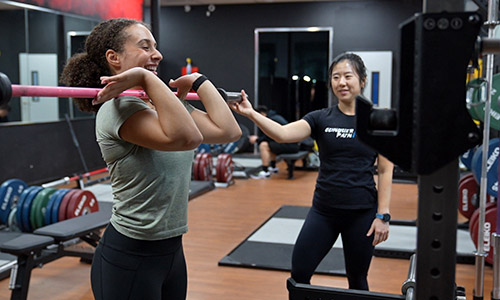
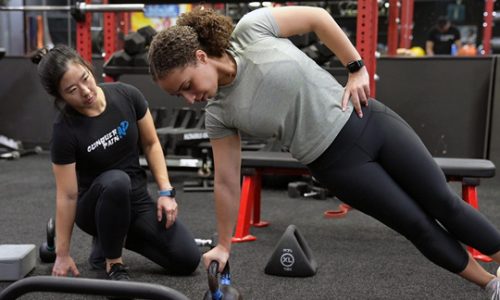
A “physical therapist who is also a personal trainer” is the rare professional who holds both. The most meaningful version of this is a Doctor of Physical Therapy who also holds a CSCS (Certified Strength and Conditioning Specialist) from the NSCA. The CSCS is the gold-standard strength credential, the same one held by college and professional strength coaches. When you see “DPT, CSCS” after someone’s name, that is your shortcut.
You will see this combination in practice in a few ways:
- A clinician who treats your injury and then transitions you into ongoing strength coaching once you are pain free
- A coach who can write a real lifting program but who can also assess and treat the elbow tweak you got on cleans last week
- A provider who programs your rehab and your training as one continuous plan, not two separate buckets
If the same person can do all three, you have found what you are looking for.
Why This Hybrid Is Rare (and Worth Paying For)
A true hybrid PT is hard to find for a few reasons:
- Insurance disincentivizes it. A PT in an insurance-based mill gets paid the same whether they spend fifteen minutes or sixty minutes with you, so the model defaults to seeing three to six patients an hour and handing off the exercise portion to a tech. There is no time or financial incentive to coach the lifts.
- The credentialing burden is real. Becoming a DPT takes seven years of higher education and a license. Adding CSCS takes additional study, a separate exam, and ongoing continuing education. Most PTs do not bother.
- You have to actually train. A PT who can program and coach lifts almost always is a lifter, runner, or athlete themselves. The ones who do not train tend to write generic exercise sheets.
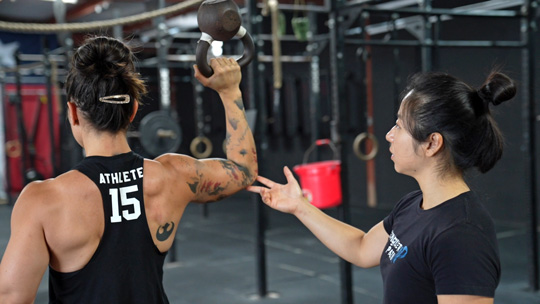
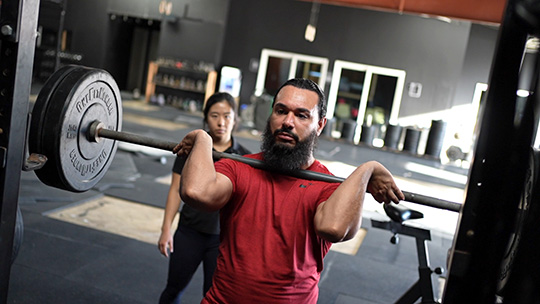
That is also why the hybrid practitioner is worth the cash rate. You get a full hour with a licensed clinician who can actually load you under a bar, watch you run, watch you snatch, and tell you what is happening in your body while you do it. You walk out with one integrated plan instead of two providers who never talk to each other.
What to Look For in a Hybrid PT
Use this as a checklist when you are evaluating a hybrid practitioner in Austin:
| What To Look For | Why It Matters |
|---|---|
| DPT and CSCS (or equivalent strength credential) | The DPT lets them diagnose and treat. The CSCS proves they actually know how to program and coach loaded movement. |
| A cash-pay or hybrid practice model | The full-hour, one-on-one model that hybrid work requires almost never survives inside an insurance-based clinic. |
| Located in or attached to a real gym | If they cannot put a barbell in your hands during the eval, they cannot truly assess loaded movement. |
| A track record with your sport or activity | Lifters, runners, CrossFitters, and obstacle course racers all move differently. Pick someone who has lived inside your sport. |
| A plan that ends, not one that drags on forever | Good hybrid practitioners get you out of pain, get you stronger, and tell you when you are done. |
| Direct communication between visits | A provider you can text with form-check videos between sessions is doing real coaching, not just selling appointments. |
| They actually train themselves | If they do not lift, run, or compete in something, they are not going to coach you well. |
Where Ninja Physio Fits In
Ninja Physio was built specifically to be the answer to this exact search.
Dr. Lily Yu, PT, DPT, CSCS is a Doctor of Physical Therapy and a Certified Strength and Conditioning Specialist. She started in PT after a half marathon injury, has competed in obstacle course racing, runs and does CrossFit and calisthenics regularly, and treats clients the way she would want to be treated as an athlete. Read her full story on the About page or meet the team.
A few things that make Ninja Physio fit the brief:
- Located inside Los Campeones Gym in north Austin. Full racks, platforms, and the equipment to actually load whatever lift is giving you trouble.
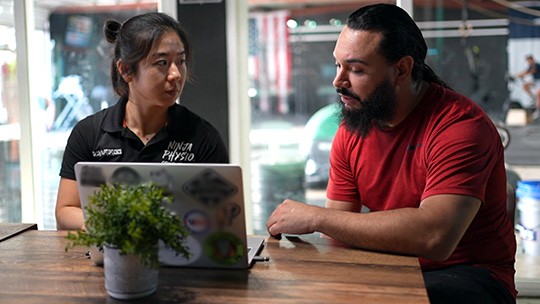
- One-on-one for the full hour, every visit. No techs, no shared appointments, no being passed off after the first five minutes.
- Cash-pay, out-of-network model. That is what makes the full hour and hybrid PT plus coaching scope possible. We can provide a superbill so you can submit to your insurance for potential reimbursement.
- Rehab and training as one program, not two. We do not “discharge” you to a trainer who has never read your eval. The strength work is built into the plan from day one.
- Direct text access between sessions for form checks, questions, and quick adjustments.
- A defined finish line. Most clients reach full recovery and return to their sport in roughly 8 to 12 weeks.
If you lift, this is the lane we live in. See our weight lifting physical therapy page for the deeper dive on how we work with powerlifters, Olympic lifters, CrossFit athletes, and recreational lifters. If you are a woman lifter looking to bridge from rehab into ongoing coaching, look at female weightlifting coaching, barbell training for women, and pain-free strength coaching for women. If you are a runner, see running physical therapy in Austin.
When You Need a Hybrid vs When You Just Need One or the Other
Honest take. Not everyone needs a hybrid PT. Here is how to think about it.
See a regular physical therapist if:
- You are post-surgical and need traditional rehab covered by insurance
- You have a chronic medical condition where insurance reimbursement matters more than the speed of return to sport
- You are not actively training and just need to walk, sit, and sleep without pain
See a regular personal trainer if:
- You are healthy, pain free, and just need someone to write a program and keep you accountable
- You have a clear goal (lose weight, build muscle, train for a 5K) and no movement issues
See a hybrid PT (DPT plus CSCS) if:
- You are a lifter, runner, CrossFitter, or athlete dealing with pain that keeps interrupting your training
- You have been through traditional PT, were discharged before you were really ready, and are now stuck
- You want to come back stronger than before the injury, not just back to baseline
- You want rehab and training to live inside the same plan
- You are tired of being told to “just rest it” by people who have never trained hard
If you read that third list and nodded the whole way through, that is Ninja Physio’s exact audience.
Common Questions
Is a physical therapist actually allowed to do personal training in Texas?
Yes. A DPT can coach strength, conditioning, and fitness work as long as they are not billing it as licensed physical therapy. A practitioner with both a DPT and CSCS can legally do both, and many of the best ones operate cash-pay precisely to keep that scope clean.
Why are these practices almost always cash-pay?
Insurance reimbursement rates do not support a full hour with a doctorate-level provider, especially one who is also coaching loaded lifts. The cash model is what makes the one-on-one, integrated approach financially viable.
Do I need a referral?
No. Texas is a direct-access state, so you can book straight with a PT here without going through your primary care doctor first.
Will my insurance reimburse anything?
Maybe. If you have out-of-network PT benefits, we can provide a superbill for you to submit to your insurer. Reimbursement varies by plan.
How long until I see results?
Most clients feel a meaningful change inside the first session and a clear trajectory within two to three weeks. Full resolution and return to sport usually lands in the 8 to 12 week range, depending on the injury and what we are training toward.
Is this only for serious athletes?
No. We work with recreational lifters in their 40s, 50s, and 60s who just want to keep training hard, runners coming back from injury, parents who want to be able to pick up their kids without back pain, and CrossFit athletes prepping for the Open. If you lift weights or run regularly and want one provider who can rehab and coach you, this is built for you.
How do I know if Ninja Physio is the right fit for me?
The fastest way to find out is to book a free discovery call. It is a real conversation, not a sales pitch. If we are not the right fit, we will tell you and point you somewhere that is.
The Short Version
If you want a physical therapist who is also a personal trainer in Austin, three things need to stack in one person: a Doctor of Physical Therapy license, a CSCS or equivalent strength credential, and a practice model that gives you a full hour of their attention inside a real gym. That combination is rare. It is also the fastest, most efficient way to fix an injury and come back better than before instead of just back to baseline.
Ninja Physio was built around exactly that model. If you want to talk through whether it is the right next step for you, schedule your free discovery call with Dr. Lily.
About the Author
Dr. Lily Yu, PT, DPT, CSCS is the founder of Ninja Physio, located inside Los Campeones Gym in north Austin. She specializes in bridging the gap between rehab and fitness for runners, lifters, and active adults who want to eliminate chronic pain and build sustainable, long-term strength.
Ninja Physio
6406 N I-35 Frontage Rd, Suite 2450
Austin, TX 78752
(512) 647-2007
