

You did not build your squat, deadlift, snatch, or clean by accident. You earned every kilo. So when something tweaks, a cranky low back on heavy pulls, a shoulder that clicks under the jerk, a knee that aches every time you hit depth, being told to stop lifting for six weeks is not rehab. It is a setback.
At Ninja Physio in Austin, we work with weightlifters the way weightlifters actually want to be worked with. Figure out what is wrong, fix the real problem, and keep you under the bar in a way that does not make it worse. No generic theraband circuits. No “just rest it.” No PT who has never touched a barbell.
Learn more about Ninja Physio and our approach.
Most physical therapy clinics in Austin are built for the average patient, someone who is not planning to put 400 pounds on their back next week. That model breaks down fast when you are a strength athlete:
We do it differently. Every session is one-on-one with a Doctor of Physical Therapy from our team who understands programming, loading, and how to coach the lifts. We build rehab into your training, not as a replacement for it.
| Injury | What It Often Looks Like in the Gym |
|---|---|
| Low back pain and lumbar strain | Pain on heavy deadlifts, conventional vs. sumo asymmetry, cannot brace at depth |
| Shoulder impingement and labral irritation | Pain in the bottom of the bench, instability in the jerk, cannot snatch overhead |
| Lifter's elbow (medial and lateral epicondylitis) | Inside or outside elbow pain on cleans, chin-ups, or heavy pressing |
| Knee pain and patellar tendinopathy | Achy front-of-knee pain in the hole of a squat or on box jumps |
| Hip impingement (FAI) and hip pinch | Pinch at the front of the hip when you try to hit depth, butt wink |
| Wrist pain in the front rack | Cannot catch cleans cleanly, wrist gives out under jerks or push presses |
| Pec, lat, and hamstring strains | Sharp event-driven pain mid-lift, lingering tightness |
| Disc herniations and sciatica | Leg pain or numbness on heavy pulls, fear of loading the spine |
| Neck pain and stiffness | Tension headaches after heavy squats, neck pain on overhead lifts |
| Ankle and foot pain | Foot pain on heavy squats, ankle mobility limiting your catch position |
| Post-surgical return to lifting | Shoulder, knee, or back surgery, needing to rebuild safely back to your platform |
Did you know that “abnormal” findings on an MRI are often not the actual cause of the pain? Over half of our clients had been previously misdiagnosed.
If you value living pain free, getting stronger, feeling younger, staying active, and are willing to do what it takes, you’ll love it here.
A real conversation with one of our Doctors of Physical Therapy, not a sales pitch. You will explain what is going on, we will ask the right questions, and we will tell you honestly whether we are the right fit. If we are not, you will still walk away with something useful. Book your free discovery call here.
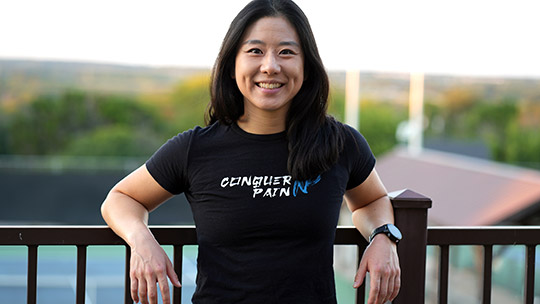
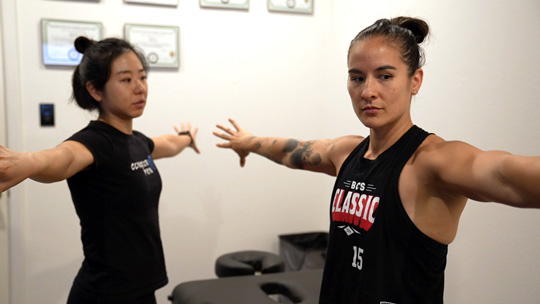
This is the part no one else does. We build your rehab to integrate with your lifting program. Accessory swaps, volume tweaks, technique cues, and targeted strength work that addresses the actual root cause. You keep training. The pain leaves.
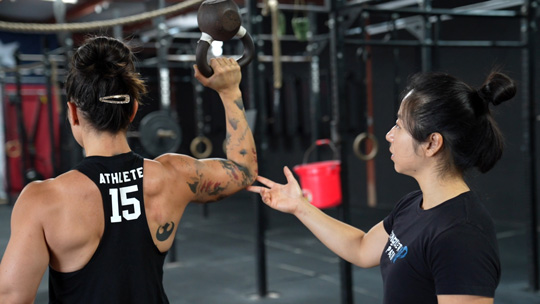
By the time we are done, you will know exactly what to do, what to avoid, and how to keep training hard without breaking down again.
No. Texas is a direct-access state, so you can book straight with us with no referral needed. See our full FAQ page for more answers.
Almost never. The whole point of what we do is keeping you training. We modify load, volume, and exercise selection so you are still progressing while the injury actually heals.
We are an out-of-network, cash-based practice. That is exactly why you get a full hour one-on-one with a Doctor of Physical Therapy and a program built for your sport, instead of fifteen minutes shared with a tech. We can provide a superbill for you to submit to your insurance for potential reimbursement.
Most lifters feel a meaningful change inside the first session and a clear trajectory within two to three weeks. Full resolution typically lands somewhere in the 8 to 12 week range, depending on the injury.
Because most PT is not built for lifters. We do not hand out generic exercise sheets. Every program is built around your lifts, your goals, and your training schedule, and updated as you progress.
Absolutely. A big portion of our work is helping lifters in their 40s, 50s, and 60s keep training hard, safely, for the long haul.
Schedule your free discovery call with one of our Doctors of Physical Therapy. We will talk through what is going on, and if it makes sense to work together, we will book your evaluation. If it does not, you will still walk away with real answers.
You can also reach us through our contact page.
